 GxPSoft AI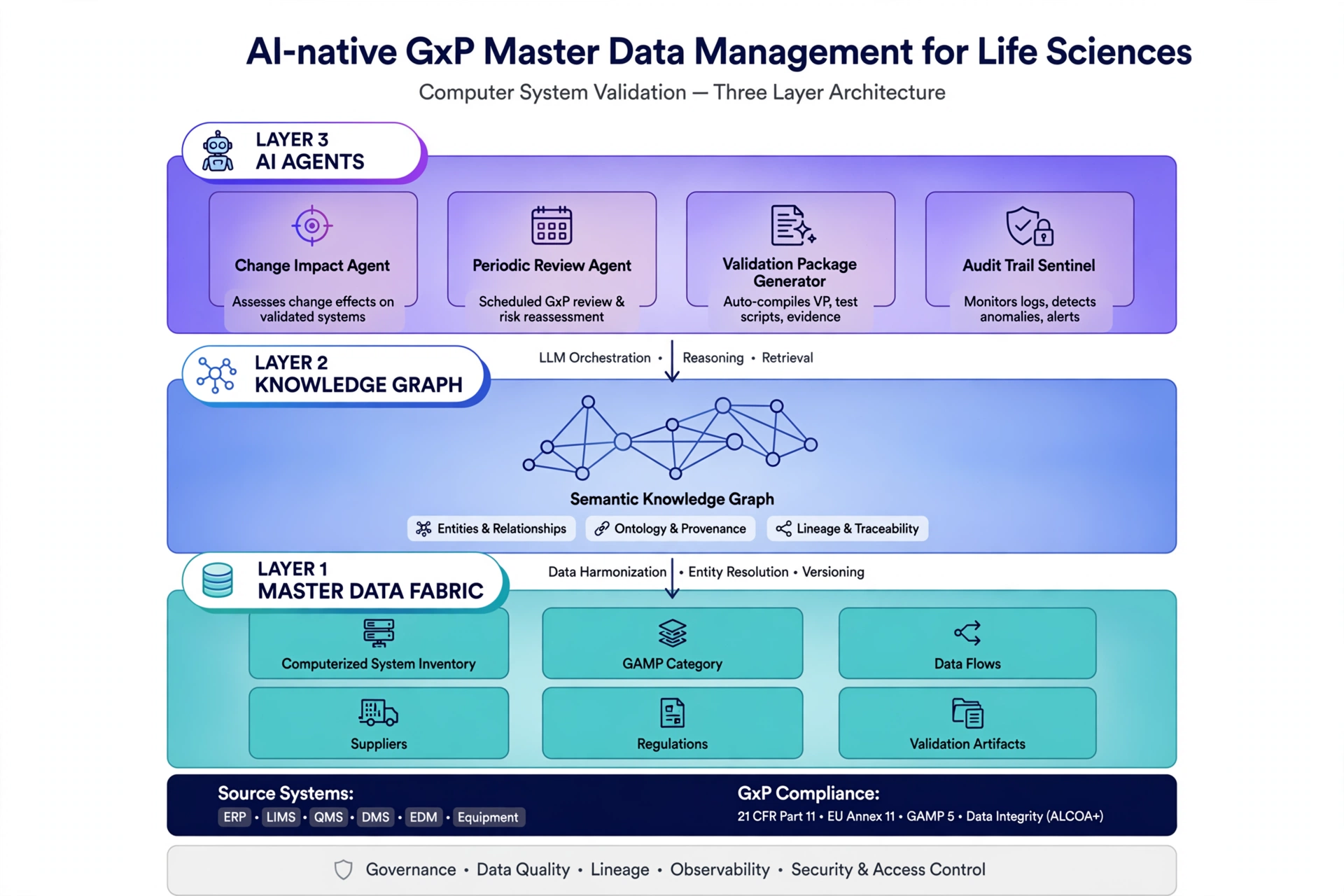
Every life-sciences AI pitch in 2026 ends the same way: “and we have a knowledge graph that grounds the agent in your validated content.” Every life-sciences AI shortfall in 2026 starts the same way too: the knowledge graph is actually a vendor’s document store, the agent reads from a single QMS table, the customer data is siloed, the audit trail is a screenshot, and the regulator-facing answer to “show me the lineage” is a CSV export.
The diagram above is the architectural pattern that actually makes the pitch defensible. Three layers. A substrate of 21 CFR Part 11, EU Annex 11, GAMP 5, and ALCOA+ data integrity underneath. Governance, data quality, lineage, observability, and security & access control as cross-cutting capabilities. Source systems (ERP, LIMS, QMS, DMS, EDM, Equipment) feeding the data harmonization layer at the bottom. The agent layer on top. The validation data fabric in the middle.
We have spent the last 90 days writing the vendor map for this stack — kneat.ai, valgenesis.com, mastercontrol.com, veeva.com, the Purolea Warning Letter, the FDA CSA finalization, the ISPE GAMP AI Guide. Today we are writing the architecture — because the architecture is the answer to a question the vendor map kept surfacing. The question is not “which vendor has the best AI.” The question is: what is the data substrate that makes any agent GxP-defensible?
The Binding Constraint Is the Data, Not the Model
On April 2, 2026, the FDA issued its first warning letter explicitly citing AI misuse under 21 CFR 211.22(c). Purolea Cosmetics Lab, FEI 3011669383, 12782 Currie Ct., Livonia. The FDA inspector found that “AI agents” had been used to produce drug specifications, procedures, and production records without adequate quality control oversight. Per RAPS coverage, the warning letter called the company out for “excessive reliance on artificial intelligence (AI) to create drug specifications, procedures, and production records, without adequate quality control oversight.” The Purolea warning letter is the first FDA enforcement action that names AI as the cause of a GxP violation. It will not be the last.
What makes the Purolea case instructive is not that the AI was “bad.” It is that the AI was operating on data the company could not defend. The agent had no version-locked ontology to ground against. The AI’s outputs were not bound to a specific validated record. The audit trail could not have produced a Part 11-defensible lineage, because the lineage was not structurally captured before the agent was deployed. The failure was in the data layer, not in the model.
This is the binding constraint. The model is interchangeable. The data substrate is not. The vendor that owns the governed, version-locked, lineage-tracked, regulatory-anchored master data layer that AI agents consume owns the infrastructure on which every other AI capability in the GxP enterprise is built. The agents atop the substrate are replaceable. The substrate is not.
This is also why the agentic-AI features shipped by Veeva, MasterControl, ValGenesis, and Kneat through 2024-2026 all converge on the same architectural pattern — drafts, not approvals; suggestions, not signatures; agents inside the validated envelope, not agents calling raw CRUD endpoints. The pattern is the model. The model is downstream of the data.
The Three Forcing Functions That Make the Architecture Real
Three regulatory and market currents make the three-layer architecture the right answer in 2026:
1. FDA CSA was finalized September 24, 2025 and updated February 3, 2026. The Computer Software Assurance for Production and Quality System Software guidance is the biggest compliance shift in CSV since EU Annex 11. Per NSF coverage: “[the] final guidance was issued on 24 September 2025 … an updated version of this guidance was issued on 3 February 2026.” CSA explicitly says “use the right assurance for the right risk” — and that is the same logic the AI vendors need to defend LLMs in GxP. AI is most defensible at the medium-risk, high-volume tier — auto-draft URS, auto-summarize deviations, auto-classify risk — and most dangerous at the highest-risk decisions. The CSA + AI bridge is the regulatory anchor for the agent layer. The data layer has to support that anchor by mapping every node to a CSA risk tier.
2. ISPE published the GAMP Guide: Artificial Intelligence in July 2025. Verified live this session via ISPE.org and the ISPE Pharmaceutical Engineering September/October 2025 issue. The ISPE AI Guide extends the GAMP 5 validation lifecycle to model context, training data, drift monitoring, and revalidation triggers. The Guide is the methodology anchor for the agent layer. It is also the methodology anchor for the data layer — because the agent’s prompts, retrievers, and tool APIs are now configuration items, and the configuration must be traced back to the validated corpus.
3. The Purolea Warning Letter (April 2, 2026) is the enforcement reality check. Any architecture that does not produce a Part 11-defensible audit trail for the agent’s inputs, outputs, retrieved documents, tool calls, and human approver will fail inspection. The data layer is the structure that makes the audit trail possible. The graph is the query substrate. The agent is the application layer. The audit trail is the cross-cutting capability that ties all three together.
Together these three forces pull the architecture toward the three-layer pattern that the diagram names. They are not the reason for the architecture — they are the reason the architecture is now regulator-defensible.
The Three Layers, As Drawn
The diagram is precise. Each layer has a job. Confuse them and the architecture breaks.
Layer 1 — Master Data Fabric (the substrate)
This is the governed, version-locked, lineage-tracked, ALCOA+-compliant store of GxP-relevant entities. The consensus canonical entities (drawing from ISPE GAMP 5 2nd Edition Appendix M3, the closed-QMS vendor ontologies, and the FDA CSA risk-question framework):
- Computerized System Inventory — every validated system, with version, vendor, GAMP Category 1-5, GxP Impact, hosting model, SOUP/COTS flag, validation status, owner, last validation date, next periodic review
- GAMP Category — the GAMP 5 2nd Edition mapping: Category 1 (infrastructure), Category 3 (non-configured COTS), Category 4 (configured COTS), Category 5 (custom)
- Data Flows — system-to-system interfaces, data type, ALCOA+ per data field, retention, encryption-at-rest, time-synchronization
- Suppliers — vendor audit, vendor release notes, SLA, qualification status, SOC 2 / ISO 27001 certificates
- Regulations — clause-level mapping: 21 CFR Part 11.10(a), Annex 11-7, GAMP 5 2nd Ed App M3, ISPE AI Guide, CSA risk questions, ICH Q9 (FMEA)
- Validation Artifacts — URS, FRS, IQ/OQ/PQ, RTM, Periodic Review, version-controlled, ALCOA+-tagged, link to the System that produced them
The data harmonization layer underneath the entity model is the entity-resolution + versioning engine that takes heterogeneous source data and produces a canonical golden record. Six source systems are named in the diagram: ERP, LIMS, QMS, DMS, EDM, Equipment. The harmonization layer is what makes the source-system data queryable.
What makes Layer 1 defensible: every other layer of the agent stack depends on it. The graph cannot reason over data that is not in the fabric. The agents cannot draft without the graph. The audit trail cannot be defended without the lineage. The fabric is the substrate.
Layer 2 — Knowledge Graph (the semantic layer)
The semantic relationships between Layer 1 entities. The graph enables:
- Ontology & Provenance — every entity is linked to a regulatory clause, a GAMP category, a risk score, a control, a tested artifact
- Entities & Relationships — every relationship is typed, versioned, and tracked
- Lineage & Traceability — the graph is the audit trail. An inspector who asks “show me the validation evidence for System X” gets a graph traversal, not a document search
The reason the graph is the second layer, not the first: the graph is a representation of the data, not the data itself. The data must be canonical before it can be graphed. Building the graph first is a 2024-2025 mistake the industry is recovering from.
The reason the graph is not the third layer (with the agents below it): the agents consume the graph as substrate, not the other way around. The agents do not produce the ontology. The ontology is curated from the GxP regulatory framework plus the customer’s data.
Layer 3 — AI Agents (the application layer)
The four canonical agents in the diagram — and the four that every 2026 CSV/CSA buyer is asking about:
- Change Impact Agent — assesses the impact of a change (vendor patch, configuration change, infrastructure update) on the validated state. Graph traversal: System → Requirements → Risks → Tests → Evidence → SOPs → Affected systems → Audit trail. Output: GxP Impact Assessment, Risk Assessment, draft test plan. Human signs.
- Periodic Review Agent — scheduled (annual by default) review of a validated system. Graph traversal: System → Incidents → Deviations → Audit Trail Metrics → Open CAPAs → User Access Changes → Supplier Updates. Output: draft Periodic Review Report. Human signs.
- Validation Package Generator — full validation package for a new system or a revalidation. Input: System + Intended Use. Graph traversal: GAMP template → requirement templates → risk templates → test templates → RTM templates. Output: VP, URS/FRS/DS, RA, IQ/OQ/PQ scripts, RTM, VSR. Human signs.
- Audit Trail Sentinel — continuous monitoring. Input: live audit trail events from the system. Graph traversal: System → Audit Trail Spec → ALCOA+ rules → violations. Output: anomaly report, alert. Human triages.
The LLM Orchestration · Reasoning · Retrieval boundary between Layer 2 and Layer 3 is where the LLM itself sits. The LLM is interchangeable. The graph is not. The LLM’s job is to traverse the graph, retrieve relevant nodes, and assemble a draft. The LLM’s job is not to invent entities, invent relationships, or invent regulatory mappings. When the LLM has to invent, the architecture is failing.
The Substrate Underneath
The diagram’s bottom row is the regulatory substrate: 21 CFR Part 11 · EU Annex 11 · GAMP 5 · Data Integrity (ALCOA+). Every artifact that touches the data is ALCOA+-tagged. Every signature is Part 11-compliant. Every audit trail is Annex 11-compliant. The substrate is not a layer — it is the cross-cutting requirement that every layer must satisfy.
The cross-cutting capability row above the substrate — Governance · Data Quality · Lineage · Observability · Security & Access Control — is the operations layer. Every entity is governed. Every change is versioned. Every access is logged. Every data-quality rule is enforced at write time. This is where the day-2 ops cost lives.
What the Diagram Intentionally Does Not Show
Three things the diagram does not show, and that matter:
- The LLM itself. The diagram puts the LLM at the L2→L3 boundary as a generic capability, not a named product. The point is that the LLM is interchangeable. The substrate is the moat. A vendor that ships the diagram’s architecture with Claude today can swap to GPT-5.6 tomorrow without touching the validation data fabric. The validated corpus is the asset, not the model.
- The specific vendor. The diagram is the pattern. The vendor that ships it is to-be-determined. As of 2026-08-20, no vendor has shipped the full three-layer architecture as drawn. Every vendor ships Layer 2 (graph) inside Layer 1 (record store) inside Layer 3 (agent), and the agent is closed to the customer’s other systems. The diagram is the vendor-agnostic target; the gap is the opportunity.
- The compliance-in-the-loop enforcement. The diagram is rigorous about the data layer and the agent layer. The enforcement layer — “how do you prove to a regulator that the agent is operating correctly” — is mentioned implicitly via the Audit Trail Sentinel but not drawn explicitly. This is the open question the 2026-2028 industry has to solve.
The 10 Buyer-Evaluation Questions
If you are buying a validation data fabric in 2026 — or evaluating whether a vendor’s “AI” is actually a fabric in disguise — the 10 questions to ask:
- Is your master data layer a graph database, or a relational database with a graph view? Graph databases (Neo4j, Amazon Neptune) traverse natively. Relational databases force JOINs at query time. The performance and audit-trail gap matters at scale.
- Is the graph ontology pre-built for GxP, or is it a generic ontology with a “regulated-industry” connector? Pre-built GxP ontology is the answer. Generic ontology with a connector is a 2024-2025 mistake.
- Is the entity resolution versioned? Every entity record must have a version, a timestamp, and a lineage. If the vendor says “yes, we have history,” ask for the specific schema.
- Is the LLM grounded in the customer’s own validated corpus, or in a generic regulatory corpus? The ValGenesis VAL™ press release framing — “trusted guardrails across the full validation lifecycle” applied to the customer’s own approved validation documents — is the right answer. Generic regulatory corpus is the wrong answer.
- Is the agent’s prompt + retrieval index + tool allowlist a validated configuration item under change control? Pinning a model is not enough. The retrieval index, the prompt template, and the tool allowlist are also configuration items.
- Is customer data used to train any model that other customers might hit? Must not be. And the contract clause should be a single-line “no,” not a paragraph with carve-outs.
- Is the audit trail bound to the agent’s input, output, retrieved documents, tool calls, and human approver — per call? The audit trail must include all six. Missing any one is a Purolea-style vulnerability.
- Does the vendor hold ISO 42001 (AIMS)? MasterControl is the first major QMS vendor certified as of July 15, 2025. For CSV/CSA vendors, the question is whether the vendor has the cert or is racing to it. By 2027-2028, the answer will be table stakes.
- Does the AI feature reduce or eliminate the need for IQ/OQ on any tier of system? For high-risk, IQ/OQ stays. For low-risk, CSA already allows review-only. AI is the productivity multiplier, not the validator. If the vendor says “AI replaces IQ/OQ,” the architecture is wrong.
- Is the AI feature covered by the vendor’s validation package, or is re-validation the customer’s problem? The vendor should produce an IQ/OQ addendum that names the AI component, the model version, the data inputs, the human checkpoint, and the audit trail binding. If the vendor says “the customer validates the AI separately,” the architecture is not Part 11-ready.
If the vendor answers “we use AI, it’s magic” to any of those questions, walk.
What Is Still Genuinely Unsolved (Mid-2026)
- Will any vendor ship the three-layer architecture as drawn? The diagram is the architecture. The pattern is the architecture. The vendor that ships it first wins the 2026-2028 race. The vendor that ships a closed QMS with a named agent inside it (the 2024-2025 GTM) is the incumbent; the vendor that ships the substrate is the disruptor.
- Will the FDA CSA finalization push the industry to publish a public “CSA-aligned methodology” paper in 2026? The methodology is converging (CSA + AI bridge, ISPE AI Guide, ISO 42001), but the paper artifacts are not. The vendor that publishes the first public CSA + AI methodology paper probably sets the audit floor.
- Will the ISPE GAMP AI Guide (July 2025) become the de facto standard for AI in GxP, or will it be replaced by FDA guidance? The FDA’s AI/ML guidance (SaMD, 2021) is older. The ISPE AI Guide is newer. The FDA’s AI-in-drug-manufacturing guidance is pending. The hierarchy is not yet clear.
- Will the Purolea Warning Letter (April 2, 2026) be a one-off or the first of many? Per GMP Compliance coverage, the warning letter specifically cited “AI agents” as the cause of the GxP violation. The agentic-AI era in regulated software is being defined by enforcement. The question is whether the FDA uses AI-non-compliance as a 2026-2027 enforcement theme.
- Will the closed QMS vendor (Veeva, MasterControl, ETQ, TrackWise, Greenlight Guru, Qualio) ship a first-party MCP server by 2026-Q4 — and migrate their AI agents to expose the three-layer fabric? Per our August 2026 closed-QMS / API / MCP synthesis, no closed QMS vendor has shipped a first-party MCP server as of August 2026. The MCP layer is the substrate of the agentic era. The vendor that ships it builds the bridge from the closed QMS to the open agent ecosystem.
- Will the validation data fabric be open-sourced as the industry-standard GxP ontology, or will it remain proprietary? The Kubernetes-for-GxP bet is real. The vendor that open-sources the ontology turns the fabric into the substrate of the industry and the agents into the differentiator. The vendor that keeps it proprietary turns the fabric into a moat and the agents into a feature.
The Bottom Line
The CPU of the 2026 GxP AI stack is not the LLM. It is the validation data fabric. The LLM is a fast peripheral that reads the fabric, traverses the graph, and writes a draft. The fabric is the part that endures. The model changes. The substrate does not.
The architecture that makes the substrate defensible is not the closed QMS with an embedded agent. It is the three-layer pattern: Master Data Fabric + Knowledge Graph + AI Agents, with the GxP compliance substrate underneath and the cross-cutting capabilities (governance, data quality, lineage, observability, security & access control) tied across all three layers. The validation data fabric is the substrate. The agents are the application. The substrate is the moat.
The right question is no longer which vendor has the best AI. The question is: does the vendor’s stack produce a Part 11-defensible audit trail for the agent’s inputs, outputs, retrieved documents, tool calls, and human approver — per call, per system, per change? If yes, the architecture is sound. If no, the architecture is a Purolea Letter waiting to happen.
The full multi-source synthesis this post is built on lives in our Obsidian vault as gxp_validation_data_fabric_2026-08-20. Cross-references are below.
Related reading:
- When Bottoms-Up Dies, the GxP Floor Is Already There — the August 2026 thesis commentary on the GxP stack flip and where intelligence lives in the software stack now
- How CSV and CSA Vendors Are Shipping AI in a Part 11 World — the per-vendor 2026 CSV/CSA breakdown (Kneat, ValGenesis, Veeva, MasterControl, Sparta/Honeywell, GoVal, eQCM)
- Are Closed QMS Vendors Opening Up for External AI Agents Yet? — the closed-QMS / API / MCP synthesis from August 2026
- Why Your Master Data Shouldn’t Live Inside Someone Else’s Platform — the architectural counterweight to vendor-hosted MDM (Strategy A vs. Strategy B)
We build GxP-compliant open-source developer tools and agentic interfaces at GxPSoft AI. If you are designing a validation data fabric, building a GxP-native master data layer, or wiring LLMs into a Part 11 audit trail, we would like to hear from you: duke.lee@saram.io.